Crystal Tester
This is a very nice and compact peace of test equipment doesn’t thank up a lot of space on the bench when using it.
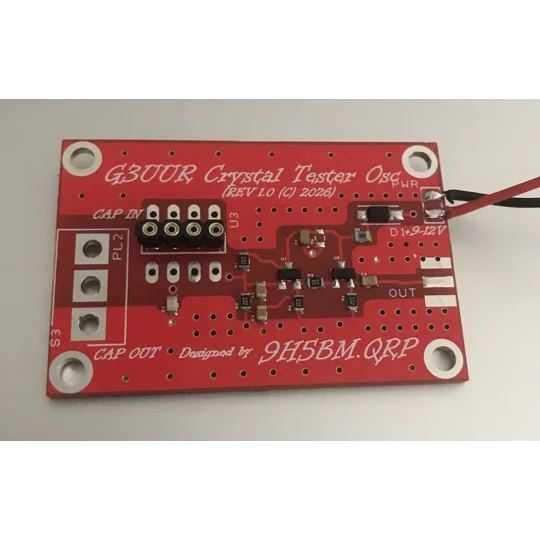
Sorting surplus crystals for a homebrew SSB filter? A nanoVNA alone won't give you the 1 Hz precision you need. This compact PCB implements the classic G3UUR crystal test oscillator. Used with a good frequency counter, it measures series resonance and motional parameters (Lm, Cm, Cp, Q) of individual crystals letting you match batches to within 50 Hz. Design ladder, Cohn, or QER filters using real data, not guesses. PCB only; components not included.
You have a bag of 100 cheap HC‑49 crystals pulled from an old computer motherboard or bought surplus for pennies each. You know that with careful selection, these humble quartz resonators can become the heart of a high‑performance SSB crystal filter – the kind that once only big manufacturers could produce. But which crystals are usable? How closely do they match? Without accurate measurement, you are simply guessing.
Building a clean, low‑ripple single‑sideband filter demands crystals whose series resonant frequencies are known to within a few Hertz. A typical nanoVNA, while wonderful for sweeping the final filter, cannot give you that resolution on individual crystals – its 101‑point scan is simply too coarse. Even with PC software interpolation, you are left wanting more precision. What you need is a dedicated, high‑resolution method: the classic G3UUR crystal test oscillator, used in conjunction with a good frequency counter (1 Hz resolution or better).
This PCB implements that very circuit. It turns your bench frequency counter into a crystal‑characterising instrument capable of sorting crystals into batches with a frequency spread under 50 Hz – tight enough for ladder filters, Cohn‑type designs, and even quasi‑equiripple (QER) variants. And yes, you can also measure the motional parameters (Lm, Cm, Cp, Q) if you follow the full G3UUR procedure.
Proven G3UUR topology – designed by Wes Hayward, W7ZOI, and others, popularised by G3UUR. Simple, stable, and repeatable.
1 Hz precision – with a good counter you can resolve frequency differences down to a single Hertz, essential for crystal matching.
No nanoVNA frustration – the oscillator gives you a clean, buffered output that any frequency counter can lock onto. No fiddling with sweep points or calibration.
Two ways to use it:
Fast sorting – measure only series resonance to group crystals by frequency. Perfect for QER or experimental filters where exact motional parameters are less critical.
Full characterisation – add a known external capacitor, measure the shifted frequency, and calculate Lm, Cm, Cp and Q using free software (AADE Filter Design, Elsie, RFSIM99, or even a spreadsheet).
The oscillator is built around a single transistor (usually a JFET or bipolar, depending on your chosen BOM). It loads the crystal very lightly, so your measured frequency is extremely close to the true series resonance. An output buffer ensures that your counter sees a clean, stable signal without pulling the oscillator.
With it you can:
Sort 100 crystals in an evening and pick the 8 or 10 that form a usable SSB filter.
Verify temperature stability and ageing of your crystals.
Design a filter with known passband ripple, shape factor, and 3 dB bandwidth – because you have real data, not guesses.
This is a printed circuit board only – the homebrewer’s choice. No components are included. You will need:
A good frequency counter (1 Hz resolution strongly recommended). Your station counter will do fine.
A regulated DC power supply (9–12 V, low noise).
Through‑hole components – resistors, capacitors, trimmer capacitor (for fine adjustment), transistor(s), and a few other parts. A full bill of materials and schematic are provided with the board.
A test fixture – simple two‑pin socket or mini‑grabber leads for the crystal.
(Optional) An enclosure – though the board can be used bare on the bench.
Solder components onto the board – it takes about an hour if you are careful.
Connect power and your frequency counter.
Insert a crystal. Read its frequency.
Repeat for each crystal in your batch. Note the values.
Use the data to design your filter. Free software will take your measured frequencies and calculate capacitor values for a ladder or Cohn filter.
For a detailed walkthrough of the G3UUR method, watch M0NTV’s excellent video “Crystal Filters for the Fearful” – the circuit on this PCB follows that same approach.
| Feature | Detail |
|---|---|
| Board size | ~65 × 40 mm (2.5″ × 1.6″) |
| Frequency range | 1 MHz to 30 MHz (covers all common SSB filter ranges) |
| Output | Buffered square wave or sine wave (depends on transistor choice) |
| Power | 9–12 V DC (regulated) |
| Construction | Single‑sided FR4, plated through‑holes, silk‑screen, solder mask |
| Mounting | 4 mm mounting holes at corners |
1 × G3UUR Crystal Test Oscillator PCB (bare board, no components) and instructions sheet included.
You could build the oscillator on perfboard or stripboard – and many have. But stray capacitance, poor grounding, and signal leakage will ruin your measurement repeatability. This PCB gives you:
A proven, compact layout with proper RF grounding.
A clean signal path from crystal to buffer.
Room for a trimmer capacitor to adjust oscillator level if needed.
No hand‑drawn schematic errors or missing decoupling.
Immediate results – just solder and measure.
Whether you are a novice homebrewer building your first SSB transceiver or a seasoned experimenter chasing the perfect filter shape, this little PCB is the tool you have been missing. Order the G3UUR Crystal Test Oscillator PCB today and turn those cheap surplus crystals into a filter that rivals commercial offerings.
Note: This is a builder’s kit (PCB only). Assembly and component sourcing required. A PDF with schematic, BOM, and construction tips is provided after purchase.
| Title | G3UUR Crystal Test Oscillator |
|---|---|
| Category | Test Equipment |
| SKU | G66Az0G |
| Condition | new |
| Weight | 50.0 g |
This is a very nice and compact peace of test equipment doesn’t thank up a lot of space on the bench when using it.
This is a very nice and compact peace of test equipment doesn’t thank up a lot of space on the bench when using it.
Johnny Padgett · 2026-09-24